Guggenheim Exhibits (Summer 2026)
Carol Bove
Rotunda, March 5 – August 2, 2026
Carol Bove is the first museum survey of the American sculptor (b. 1971, Geneva; raised in Berkeley, California; lives and works in New York). Organized by curator Katherine Brinson, it fills the entire rotunda with roughly one hundred works spanning more than twenty-five years, from early assemblages of paperback books and paper collages to the monumental steel sculptures of the past decade. The chronology is inverted: recent work appears at the bottom of the ramp, the oldest at the top. Two site-specific additions accompany the survey. A new outdoor sculpture, Victoria (2026), stands in front of the museum. Inside, a diamond-shaped cutout in the ramp wall reveals, for the first time in decades, part of a mural by Joan Miró and Josep Llorens Artigas that was built into the building in the 1960s.
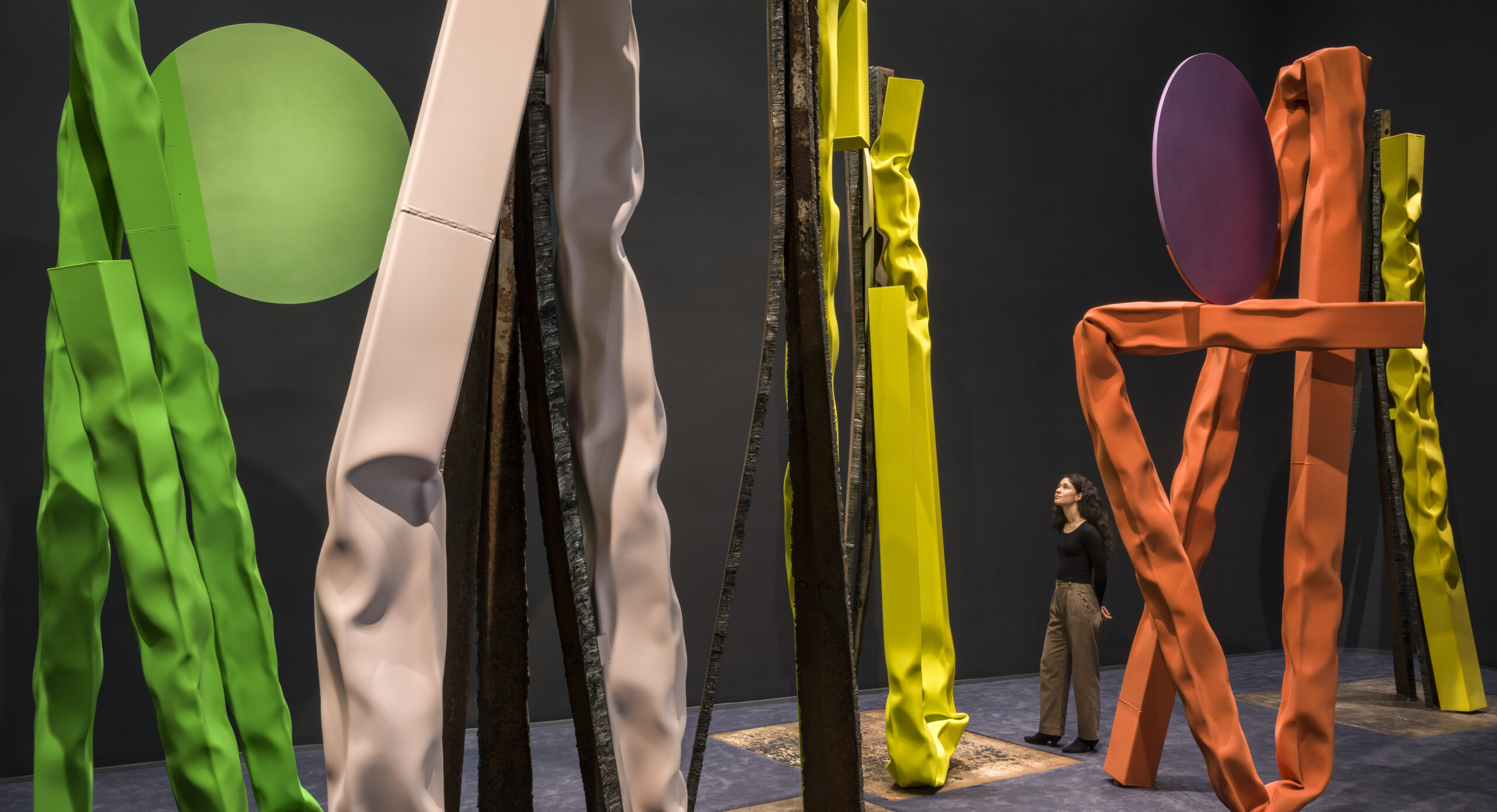
Sweet Charity (2026) is an installation of towering crushed-steel beams and polished discs conceived for the High Gallery. Alex Greenberger, reviewing the show for ARTnews, called it "the star work of the Guggenheim show," writing that it "takes on the proportions of a forest, its steel beams rising high above the heads of even the tallest viewers," with crushed steel that "appears lush and flowy, like the drapery in a Bernini sculpture." Polished discs related to the piece recur on every level of the ramp, forming what Greenberger described as "a spine of sorts for the show." According to his review, the discs themselves come from The séances aren't helping, Bove's 2021 commission of four sculptures for the facade niches of the Metropolitan Museum of Art; after that installation closed in November 2021, she reused the components in the present exhibition.
Assemblage and the readymade

Bove became known in the early 2000s for shelf-based arrangements of found objects — paperback books, magazines, and ephemera evoking the counterculture reading lists of the 1960s — and later for installations combining driftwood, peacock feathers, seashells, and industrial metal. These works belong to the tradition of assemblage, the practice of building art from existing objects and cultural debris. The tradition descends from Marcel Duchamp's readymades of the 1910s and runs through the mid-century work of Joseph Cornell's boxed arrangements and Robert Rauschenberg's Combines.


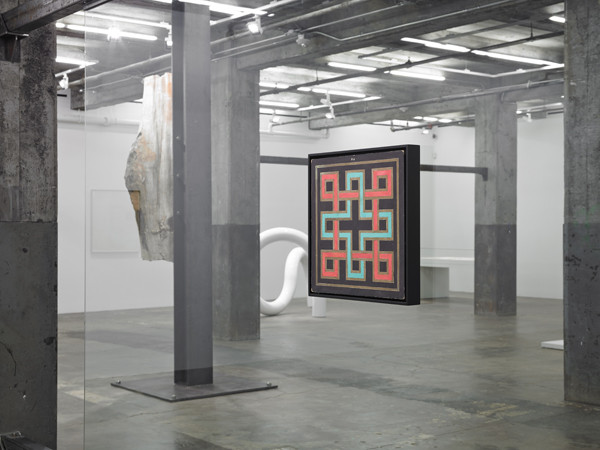
The exhibition catalog, in an essay by Cathleen Chaffee, uses the term "para-artworks" for a related strand of Bove's practice: her re-presentation of other artists' and non-artists' works within her own displays. A recurring example is the archive of Lionel Ziprin (1924–2009), a Lower East Side poet and Kabbalist whose apartment salon was a center of the 1950s–60s esoteric underground. From 1958 to 1962 Ziprin ran the QOR Corporation, a small company that tried to commercialize mylar-laminate designs based on occult geometric principles; the designs were made with his collaborator Harry Smith, the avant-garde filmmaker who compiled the Anthology of American Folk Music. The venture failed, and its materials went unseen for decades. Bove acquired the archive from Ziprin's daughter around 2010. In 2013 she co-curated its first public exhibition, at Maccarone gallery in New York, while a show of her own sculpture ran at the gallery at the same time — Smith's painting and unattributed Ziprin drawings were displayed among her works. In 2023 she helped conceive the Whitney Museum's Harry Smith retrospective. Ziprin drawings appear again in the Guggenheim survey. Chaffee has written that Bove's "exhibitions register the drift between art and non-art. For Bove, the murky, often seemingly magical passage from thing to art object, from collectable to readymade, is not a permanent transformation."
Steel sculpture after 1945
The monumental works of Bove's last decade engage a specific postwar American lineage: welded and crushed steel. David Smith, a former automobile-factory welder, established welded steel as a primary sculptural medium in the 1940s–60s; his late Cubi series stacked burnished stainless-steel volumes into open, geometric compositions. John Chamberlain, beginning in the late 1950s, made sculpture from crushed automobile-body steel, keeping the found factory colors; he described the works as governed by "fit" and color rather than by their automotive source, and rejected readings of them as commentary on car culture.


A second reference point is Minimalism, the reduced geometric sculpture of Donald Judd, Tony Smith, and Richard Serra in the 1960s–70s. Minimalist works were typically fabricated industrially from materials such as steel, aluminum, and plywood, often as a series of identical units.

Critics have read Bove's steel against both lineages. Where Chamberlain's crumpled metal retains the evidence of impact, Bove's tubes are crushed and then finished in smooth, uniform urethane paint, producing what critics have repeatedly described as an illusion of softness. Gordon Hughes, writing in Artforum, described the experience of one work as seeing it "wrongly: as soft, thick folds of draping fabric transforming into crumpled cardboard or rubber tubing"; the critic John Haber wrote that in her hands "the same welded metal seems downright pliable, like fabric or flesh, but it also refuses to be crushed." The Nasher Sculpture Center's catalog for her Collage Sculptures exhibition describes "an appearance of almost impossible softness, as if steel could become as pliable as clay." Bove has said of these effects: "Maybe our grip on reality should be a little lighter … enabling us to see what is in front of us rather than only what we think we see." Greenberger contrasted her "glyphs" — looping painted-steel spirals first shown at Documenta in 2012 — with Minimalist precedent: they are "loopy and soft-looking where most Minimalist sculptures tend to be hard, heavy." In 10 Hours (2019), Bove topped a steel monolith with a beam pressurized until it appears flimsy, a gesture Greenberger called "about as far removed from Serra's machismo as one could get."
Installation in the rotunda

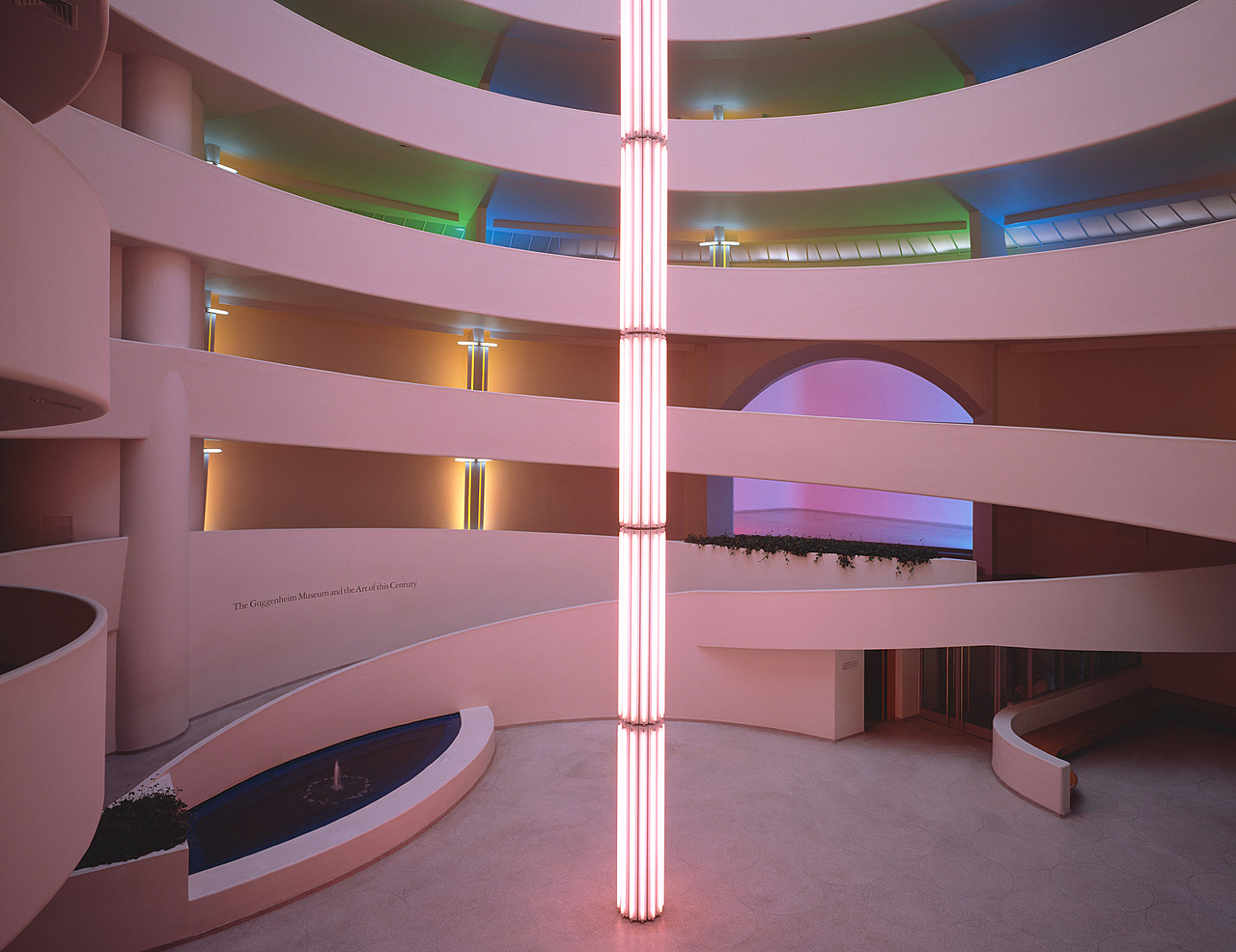
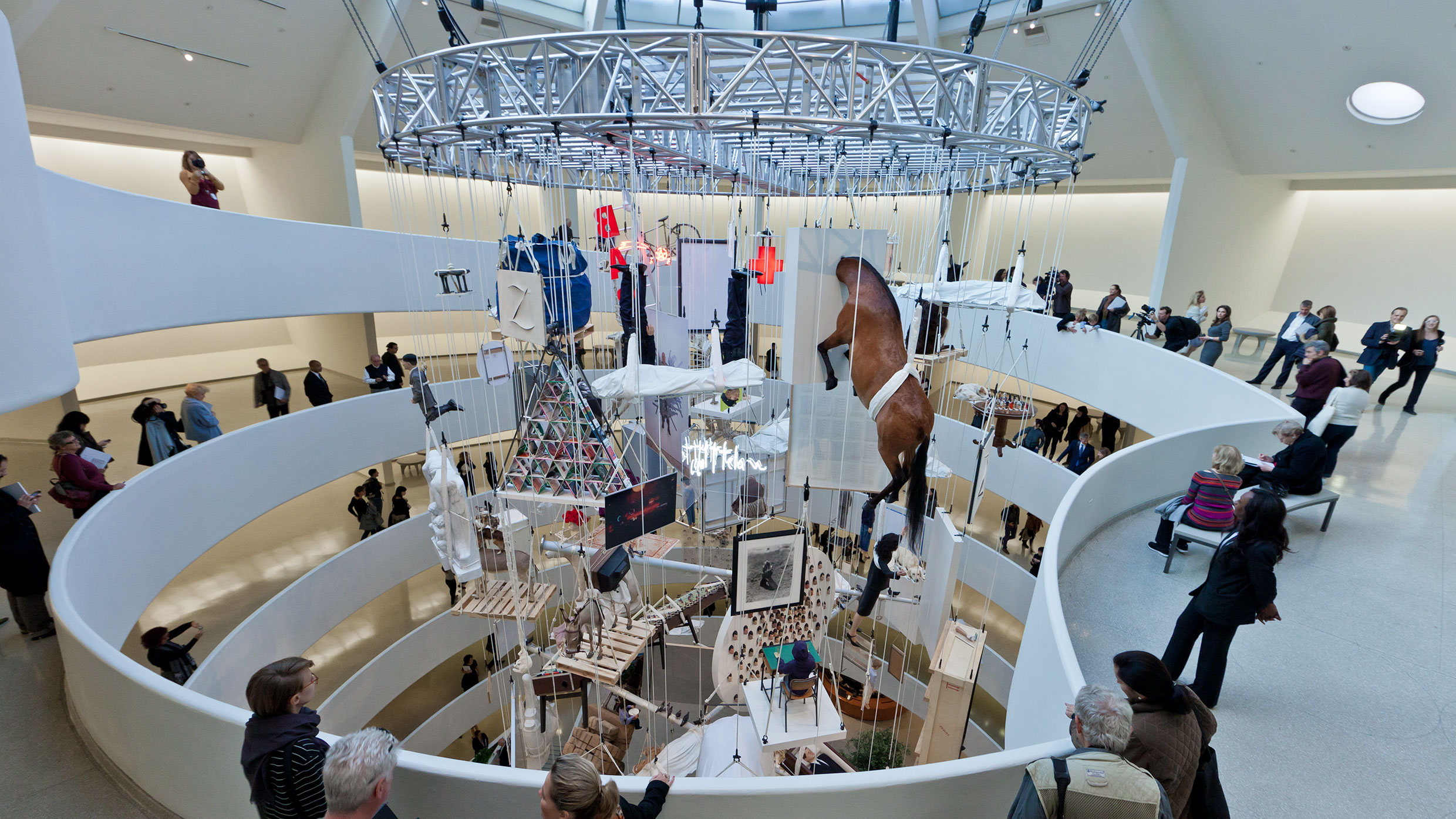
Frank Lloyd Wright's spiral ramp (1959) has been contested as an exhibition space since before the building opened: in 1956, twenty-one artists including Willem de Kooning and Franz Kline signed a letter protesting that the sloped, curved galleries were unsuitable for viewing paintings. Later artists have instead treated the building as material for the work. Dan Flavin's untitled (to Tracy, to celebrate the love of a lifetime) (1992), made for the reopening of the restored rotunda, ran a column of pink fluorescent light up the full height of the atrium and washed the ramps in colored light; Maurizio Cattelan's retrospective All (2011) suspended the artist's entire output on ropes from the oculus.
The Guggenheim's exhibition text places Bove in this line, stating that she "approaches the building as a sculpture in its own right, subtly activating its distinctive geometries and open sight lines."
Reception
Reviews diverged on the survey's scale. Greenberger's ARTnews review found the recent work "lush, extravagant, and formalist — all qualities that lend Bove's recent work an edge in an art world still dominated by cold-eyed conceptualism." Seph Rodney, in a more critical review for Hyperallergic, praised individual works — "It's wondrous that Bove has taken material used in the construction of buildings, firearms, and bridges and made it feel like a piece of fabric nonchalantly deposited and forgotten" — but argued that the exhibition "feels like it's drowning in the museum's ambitions," writing that "a smaller survey would have allowed for something more meaningful than just telling us what Bove has been doing for the past decades."
Guggenheim Pop: 1960 to Now
Tower galleries 4, 5, and 7, June 5, 2026 – January 10, 2027
Guggenheim Pop: 1960 to Now presents the museum's Pop art holdings alongside recent acquisitions by contemporary artists, drawn entirely from the Guggenheim's own collection. The show includes twenty-nine artists and is organized by curator Lauren Hinkson. Tower 5 holds the 1960s core. Tower 7 holds works derived from performance and participation, including Yayoi Kusama's Infinity Mirrored Room – Dancing Lights That Flew Up to the Universe (2019), a mirror-lined chamber in which points of light repeat toward an apparently endless horizon. The contemporary section, opened June 26, occupies Tower 4. The museum's text states that the show "illustrates how Pop renders the familiar strange, elevates the commercial to the sacred, and transforms the banal into the spectacular."
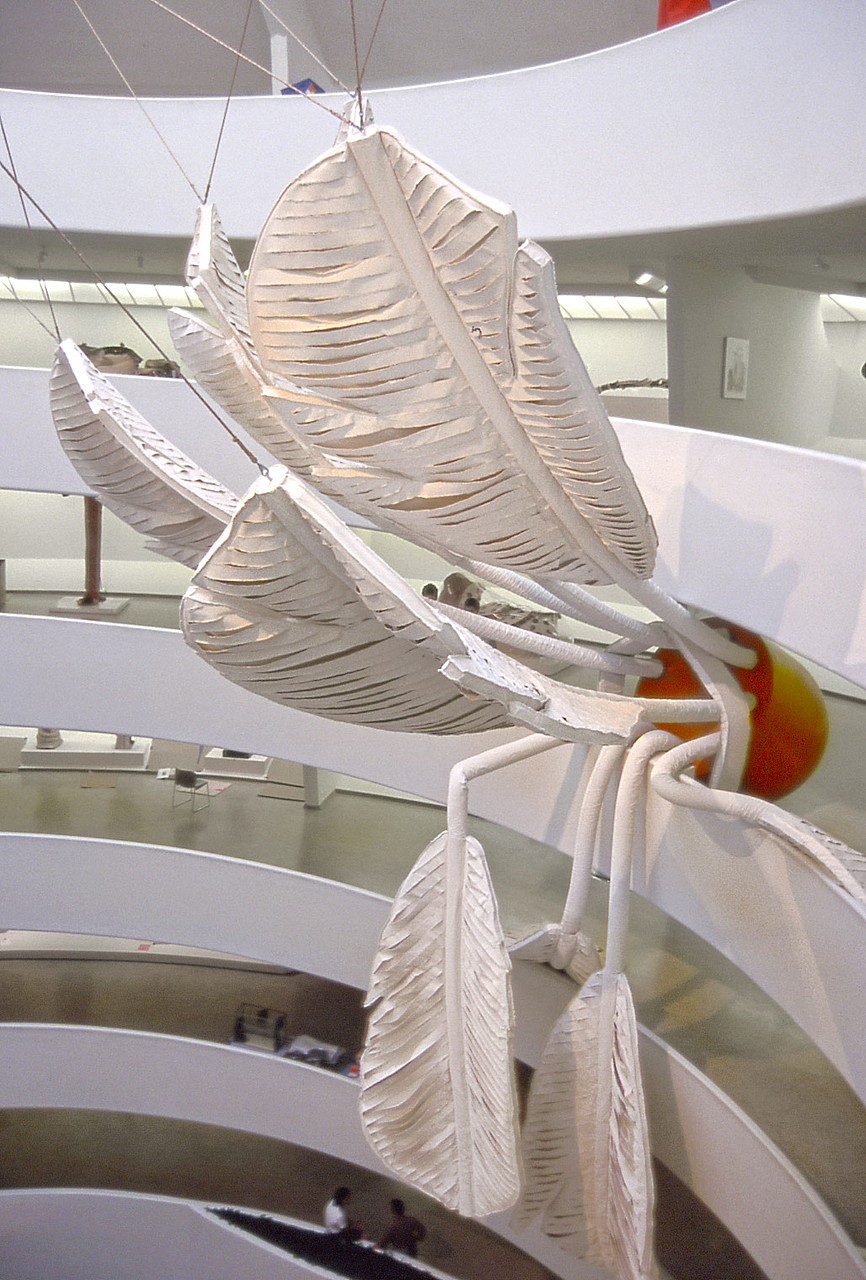
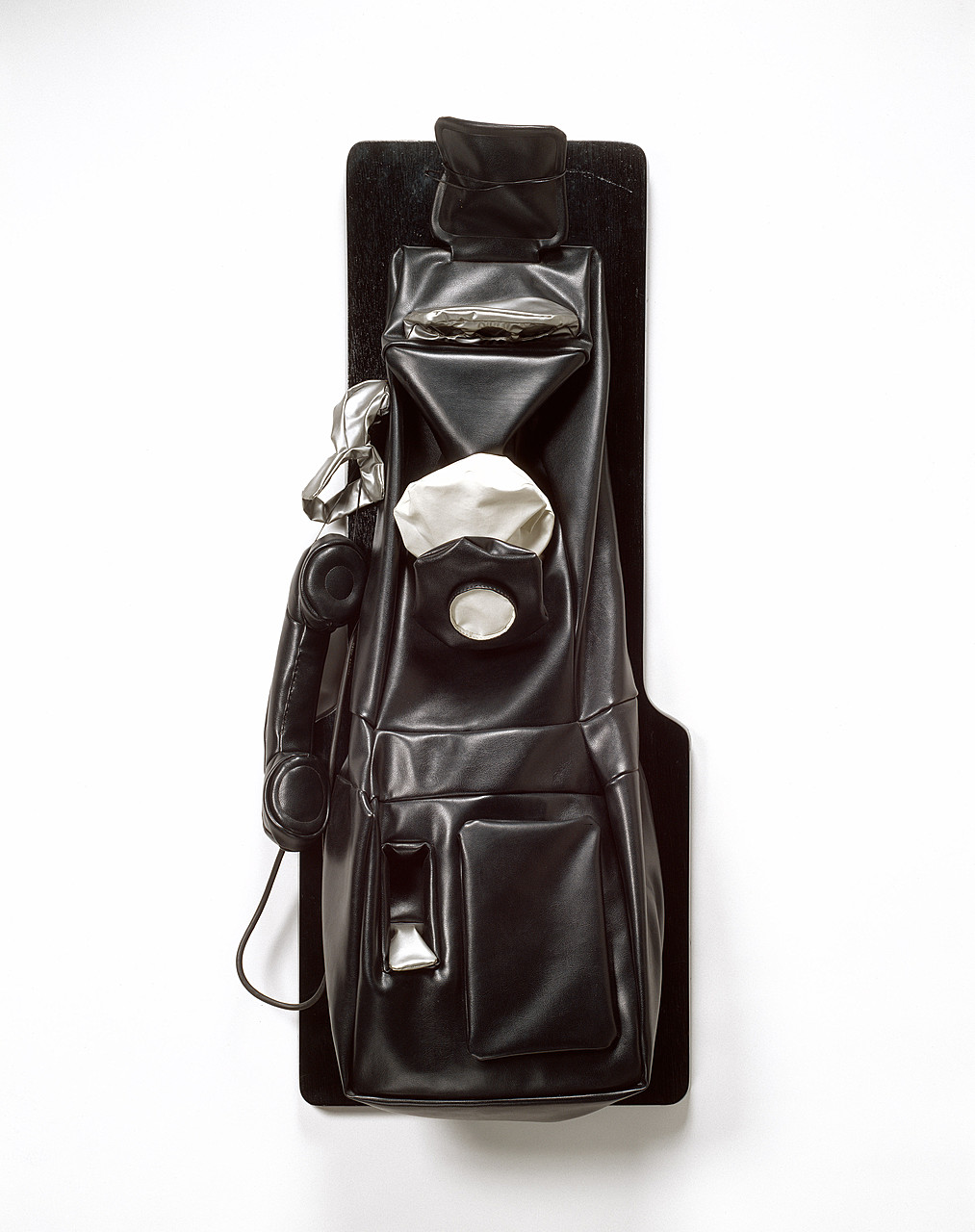
The exhibition's largest work is Claes Oldenburg and Coosje van Bruggen's Soft Shuttlecock (1995), a monumental fabric badminton birdie on view in New York for the first time in twenty-five years. Richard Selden, reviewing the show for The Georgetowner, wrote that it dominates the exhibition "like a giant albino squid, its orange head wedged in a corner," and that "it alone … is reason enough to pop in when you're in New York."
Before Pop: the readymade and Neo-Dada

Before Pop, the idea that a mass-produced object could be art belonged to Marcel Duchamp. His readymades of the 1910s — a bicycle wheel, a bottle rack, the urinal titled Fountain (1917) — were ordinary manufactured things exhibited as sculpture. The gesture found few takers in its own time: the originals were mostly lost or discarded, and by mid-century Duchamp had largely withdrawn from making art, spending much of his time playing chess.
In the mid-1950s, Duchamp's ideas resurfaced in the work of two younger New York painters, in what critics called "Neo-Dada." Jasper Johns — who studied and collected Duchamp — painted American flags, targets, and numbers in encaustic; Robert Rauschenberg built his Combines from quilts, newsprint, and street debris. After two decades dominated by the abstraction of Pollock, de Kooning, and Rothko, their work brought everyday imagery back into painting, and Neo-Dada is conventionally treated as the bridge between Abstract Expressionism and Pop.
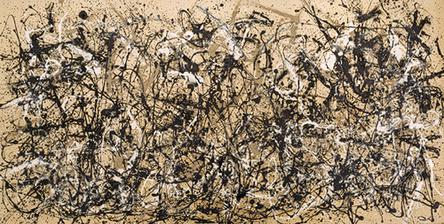

Recognition reached Duchamp himself only as Pop arrived. His first museum retrospective was held in 1963, at the Pasadena Art Museum, with Warhol at the opening; the next year he authorized an edition of replicas of the lost readymades. He was not entirely pleased with his heirs. In a remark reported by the Dada chronicler Hans Richter, he complained: "I threw the bottle-rack and the urinal into their faces as a challenge and now they admire them for their aesthetic beauty."
British origins
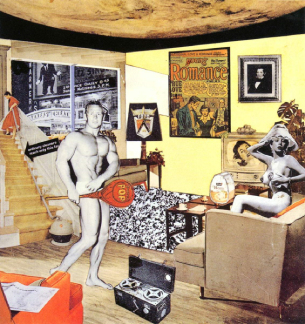
Pop emerged first in London. The Independent Group — including Richard Hamilton and the artist John McHale — met at the Institute of Contemporary Arts in the early 1950s to discuss advertising, science fiction, and American consumer culture. Hamilton's small collage Just what is it that makes today's homes so different, so appealing?, made for the 1956 Whitechapel exhibition This Is Tomorrow, is often cited as the first Pop artwork. In a 1957 letter, Hamilton defined the territory in a list: Pop art should be "Popular (designed for a mass audience), Transient (short-term solution), Expendable (easily forgotten), Low cost, Mass produced, Young (aimed at youth), Witty, Sexy, Gimmicky, Glamorous, Big business."
American Pop
American Pop reached public attention in 1962, the year of Warhol's first soup-can exhibition in Los Angeles and the Sidney Janis Gallery's International Exhibition of the New Realists in New York (November 1 – December 1, 1962), after which Mark Rothko, Robert Motherwell, Adolph Gottlieb, and Philip Guston resigned from the gallery in protest. The core artists worked with mechanical or quasi-mechanical means: Warhol with photographic silkscreen, Lichtenstein with hand-painted enlargements of the Ben-Day dot patterns of comic-strip printing, Oldenburg with sewn vinyl and canvas versions of food and appliances. Warhol told ARTnews in 1963, "The reason I'm painting this way is that I want to be a machine." Lichtenstein, in the same interview series, said of his comic-strip sources: "It was hard to get a painting that was despicable enough so that no one would hang it — everybody was hanging everything." In January 1964, Life magazine ran its profile of Lichtenstein under the headline "Is He the Worst Artist in the U.S.?"

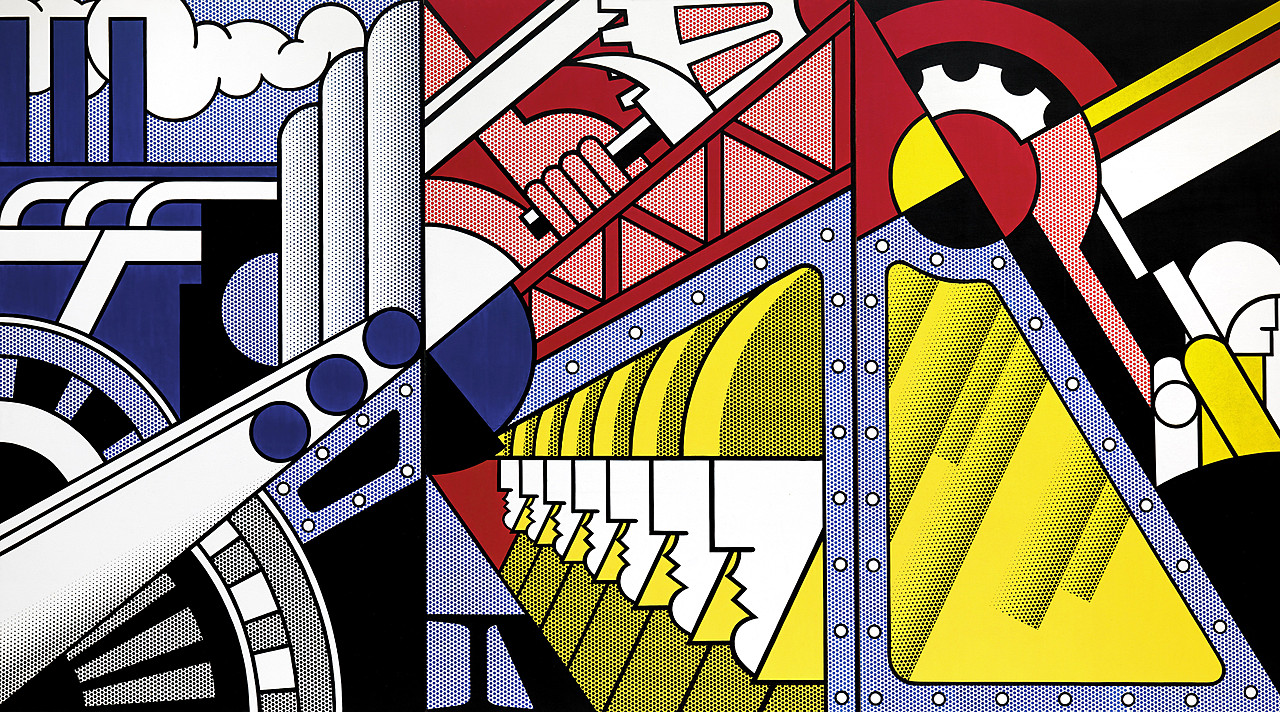
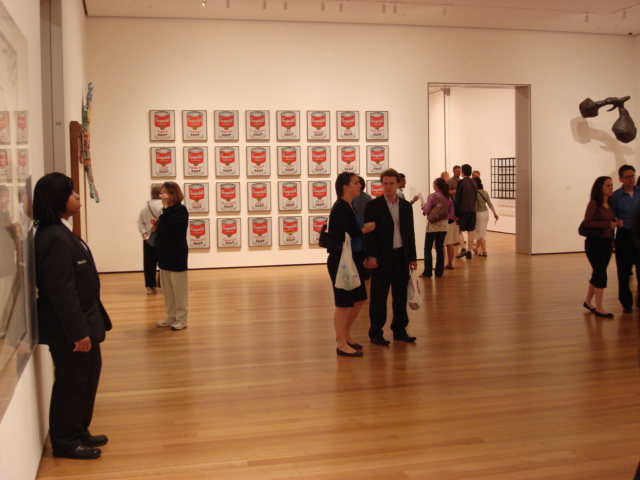
The Guggenheim's Warhol, Orange Disaster #5 (1963), belongs to his Death and Disaster series rather than his consumer imagery: an electric chair repeated fifteen times in silkscreen over orange acrylic. Warhol said of such images in the same 1963 interview: "When you see a gruesome picture over and over again, it doesn't really have any effect." Lichtenstein's Preparedness (1968), a mural-scale painting of interlocking soldiers and machinery made at the height of the Vietnam War, represents the movement's occasional turn to overt political subject matter.
Pop as a continuing strategy

The exhibition's contemporary section argues, in curator Lauren Hinkson's words, that "Pop art, as a strategy, continues to inspire, provoke, and evolve." Maurizio Cattelan is its most direct link to the museum's own history: his America (2016), a fully functional 18-karat gold toilet, was installed in a Guggenheim restroom for a year and used by roughly 100,000 visitors. In 2017, when the White House asked to borrow a van Gogh, curator Nancy Spector declined and offered America instead; the offer went unanswered. The museum also acquired Cattelan's Comedian (2019) — the banana duct-taped to a wall — by anonymous gift in 2020, and it is a listed highlight of the show. The contemporary roster extends Pop's vocabulary to artists including Alex Da Corte, whose videos and installations restage pop-culture icons in saturated color; Lauren Halsey, who monumentalizes the signage and commercial vernacular of South Central Los Angeles; Wendy Red Star, who reworks archival imagery of her Apsáalooke (Crow) community; and Farah Al Qasimi, whose photographs record the consumer interiors of the Persian Gulf.
Reception
Richard Selden wrote in The Georgetowner that "more than six decades later … the movement's rebellion against abstraction and its often kitschy, occasionally political embrace of the aesthetics of comic books, advertising and our disposable society remain vital." Sandra Bertrand of Highbrow Magazine described "a continuing fondness for the commonplace made new" and called the museum's claims for Pop "a high order indeed!", while noting that the historical Pop galleries read "almost as an afterthought to the expansive solo exhibition of Carol Bove's sculptural assemblages."
Sources
- Solomon R. Guggenheim Museum, exhibition pages: Carol Bove; Guggenheim Pop: 1960 to Now.
- Alex Greenberger, "Carol Bove's Gripping Guggenheim Retrospective Transcends Time and Space," ARTnews, March 5, 2026.
- Seph Rodney, "An Overfilled Guggenheim Retrospective Dulls Carol Bove's Brilliance," Hyperallergic, March 5, 2026.
- Gordon Hughes, "False/Positive: On the Art of Carol Bove," Artforum, March 2026; John Haber, "David Smith in White and Carol Bove," haberarts.com; Catherine Craft (ed.), Carol Bove: Collage Sculptures, Nasher Sculpture Center, 2021; Maccarone gallery, press release for RA, or Why is an orange like a bell? and Qor Corporation: Lionel Ziprin, Harry Smith and the Inner Language of Laminates, 2013 (source of the Chaffee quote, from Bove's publication The Middle Pillar).
- Richard Selden, "Pop — Past and Present — at the Guggenheim," The Georgetowner, June 25, 2026; Sandra Bertrand, "Pop Art Is Back in Town at the Guggenheim," Highbrow Magazine, July 8, 2026.
- Gene Swenson, "What Is Pop Art? Answers from 8 Painters, Part I," ARTnews 62, November 1963 (Warhol and Lichtenstein interviews); Richard Hamilton, letter to Peter and Alison Smithson, January 16, 1957 (Tate); Dorothy Seiberling, "Is He the Worst Artist in the U.S.?," Life, January 31, 1964.
- On Cattelan: artnet News on the museum's acquisition of Comedian; The Art Newspaper on America and the 2017 White House loan request.
- Hans Richter, Dada: Art and Anti-Art (1965), source of the Duchamp remark on the readymades' revival.
- Guggenheim 2026 exhibition schedule press release.
- Images: Wikimedia Commons (public domain and Creative Commons as captioned); guggenheim.org (installation photography by David Heald © Solomon R. Guggenheim Foundation; collection images © the artists' estates as captioned); en.wikipedia.org (Hamilton collage, fair use). Images are hotlinked for personal reference use.